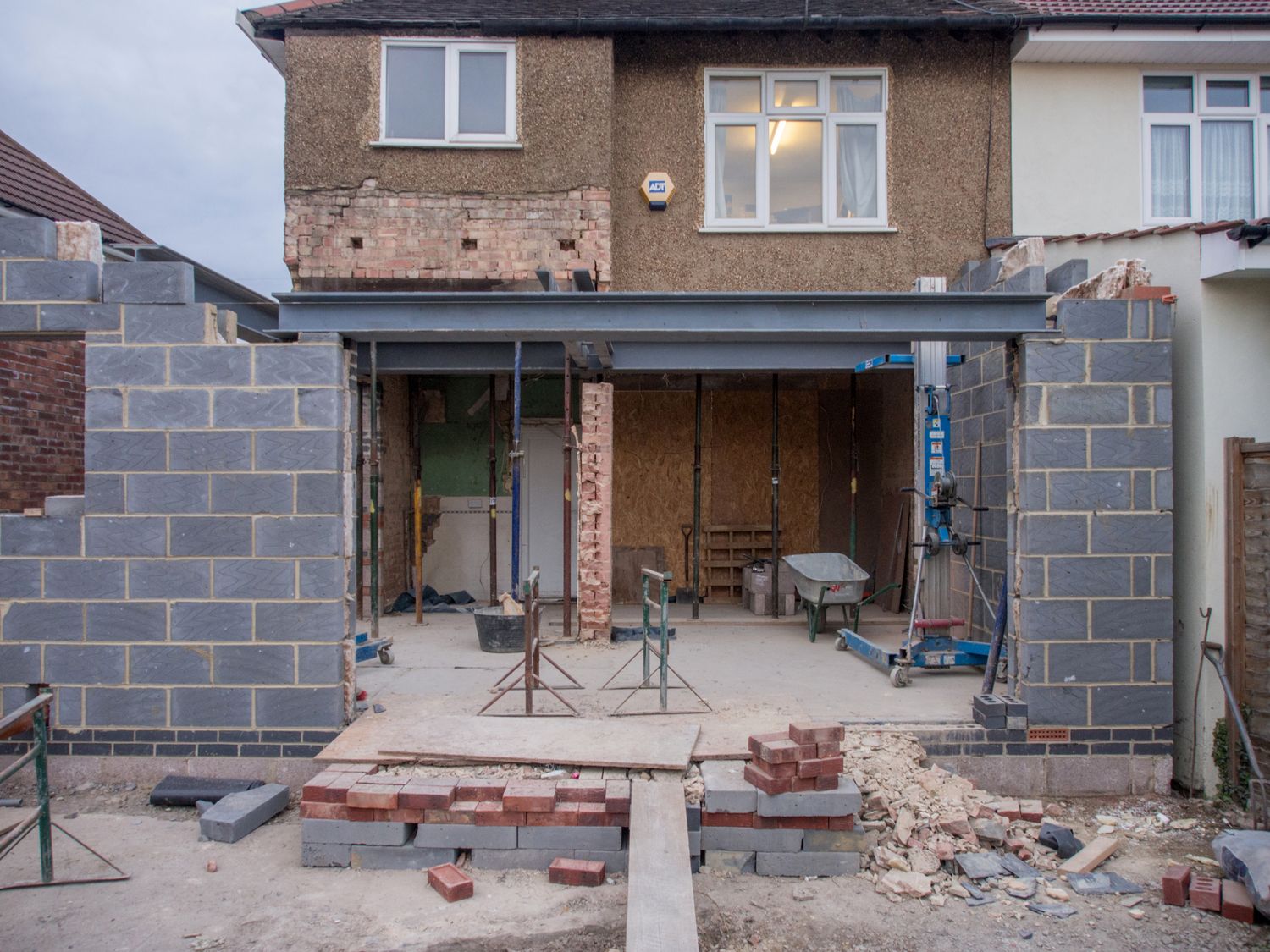
The word ‘rear’ does not determine whether a party wall notice is required. The actual boundary position, work to any shared wall and the foundations are the deciding details.
Set the extension out from the boundary
Ask your designer to show the legal boundary and both faces of each proposed wall on a dimensioned plan. A wall wholly on your land, a wall built up to the boundary and a wall proposed astride it are not the same proposition. If the design involves a new wall at the line of junction, section 1 of the Party Wall etc. Act 1996 may apply. Building across the line normally requires the adjoining owner's written consent; you cannot treat silence as permission to build on their land.
Check the foundations before selecting a start date
A rear extension beside a neighbour's house may involve excavation within three metres of their building, or within six metres in particular deeper-excavation circumstances. Distance alone does not decide the issue: foundation depths and the statutory tests matter. Ask the designer for foundation sections, proposed depths and the location of neighbouring structures. If section 6 applies, the notice needs technical information and drawings that our automated builder cannot produce.
Separate planning permission from neighbour notices
Some rear extensions qualify for permitted development, whereas others need planning permission or a larger-home-extension prior approval process in England. These routes have different rules from the Party Wall Act. Building regulations still address structural safety, drainage, insulation and other matters. Receiving planning approval does not remove any duty to serve a party wall notice, and a neighbour's party wall response is not the same as a planning objection.
Keep the build sequence realistic
Confirm drainage runs, access for materials and how the new opening will be supported before fixing a contractor date. If a steel beam will bear into an existing shared party wall, that work may need a party structure notice with a different notice period from a boundary-wall or excavation notice. Some extensions require more than one type. Put notices on your programme early, not after the builder has booked the excavation team.
Does this project need a party wall notice?
A rear extension does not automatically need a notice. Section 1 can apply to a new wall at the boundary; section 3 can apply to specified work on an existing party wall; and section 6 can apply to nearby excavations. Check each actual operation separately. The free checker can help with supported straightforward section 1 or 3 drafts, but not section 6 excavations.
Checklist before work begins
- Mark the proposed walls and boundary on one plan.
- Obtain foundation depths and a section drawing from the designer.
- Identify any beam pockets or other changes to a shared wall.
- Check the appropriate notice period before scheduling work.
Think you may need a notice?
Check your work for free. A personalised £4.99 PDF is available only if it fits the builder’s supported notice types.
Related guides
GOV.UK party wall explanatory booklet ↗ · Party Wall etc. Act 1996 ↗ · Planning Portal project guidance ↗
Last reviewed: 22 October 2026. Information is not a substitute for professional assessment of your project.